The season · Seasonal Edits
Three Pieces That Cover the Widest Temperature Band
Three spring layers chosen by usable temperature range rather than season: a cotton overshirt, a 12-gauge knit and an unlined cotton coat.

A day that starts at 46°F and ends at 68°F defeats a wardrobe organized by season. The coat is too much by noon and the shirt alone is too little at eight in the morning. Buying by usable range instead — the span of temperatures a garment stays on without adjustment — turns three pieces into most of a spring wardrobe.
A band is narrower than a season
A season is a calendar claim. A band is a temperature claim, and it has two edges. The low edge is the point where the piece alone stops being enough; the high edge is the point where it has to come off. Between them the garment needs no thought.
Bands are usually two to three times narrower than the seasons they get sold under. A “spring coat” marketed for March through May may have a genuine band of 16°F, from 44 to 60. That is not a fault in the coat, only in describing it by month.
What moves the band
Three properties set the edges. Cloth weight, measured in GSM, sets how much heat the fabric holds. Openness of weave or knit sets how quickly air moves through it. Whether the front closes sets how much of the body is exposed to moving air. A 300 GSM cotton twill and a 300 GSM open linen can weigh the same and differ by 12°F, because the linen passes air and the twill resists it.
The second number is insulation, measured in clo. ASHRAE 55’s comfort charts pair a 1 clo assembly with roughly 68 to 75°F and a 0.5 clo assembly with roughly 73 to 79°F, which works out at 8 to 10°F of ambient per clo. A mid-weight overshirt is worth about 0.25 clo, so about 2°F at the low edge; an unlined cotton coat is worth about 0.45 clo, so about 4°F. Stack both over the same knit and the low edge drops by roughly 6°F. That is the whole mechanism behind layering, and it is why a fourth layer buys less than the first three.
The overshirt: 48 to 66°F
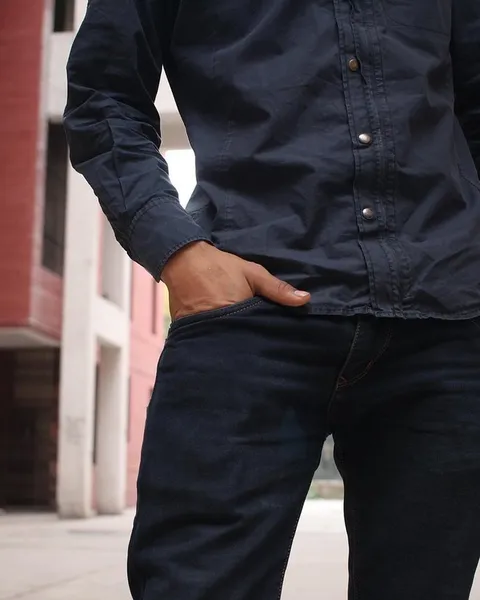
An overshirt, cut with the ease and pocketing of a light jacket, has the widest single band of the three. Open over a tee at 66°F it reads as a layer rather than a shirt; buttoned over a knit at 48°F it holds warmth at the neck and wrist, which is where heat leaves first.
The specification that matters is 200 to 240 GSM cotton twill. Below 180 GSM the cloth is a shirt and the band narrows to 56 to 72°F. Above 260 GSM it stops draping and starts behaving like a jacket, which is fine except that it then competes with the coat. Sleeve length should reach the wrist bone; a short sleeve leaves the wrist cold first. The body should clear the waistband by about two inches, enough to sit over a knit hem without riding up.
Closure matters more than weight at the bottom edge. A full placket buttoned to the collar is worth about 2°F at the low end compared with the same cloth worn open. A light knit under a heavy shirt works because the knit is smooth enough not to bunch at the armhole.
The 12-gauge knit: 50 to 66°F
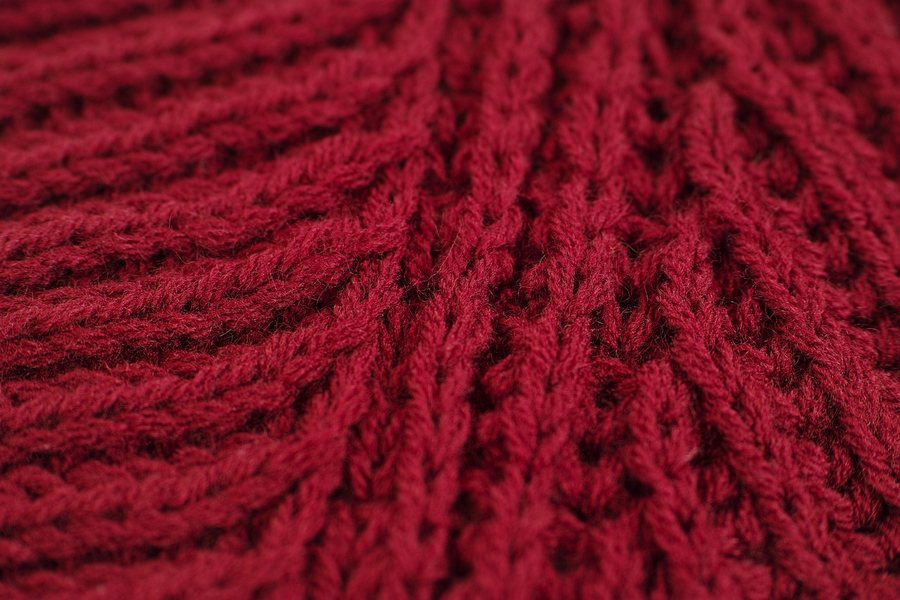
Gauge is needles per inch, and 12 sits at the fine end of ordinary knitwear: close enough to wear under a jacket, dense enough to wear alone. In merino at 280 to 320 grams it covers roughly 50 to 66°F as a single layer, and 38 to 55°F under an unlined shell.
Two construction details decide whether it earns that band. A set-in shoulder keeps the seam on the shoulder bone and lets the knit sit under a coat without adding width. A dropped shoulder puts fabric on the upper arm and makes the same yarn read as outerwear, which pushes the piece into a different slot. A 2-ply yarn resists pilling better than a single, because more fiber is twisted into each strand, and the rib at cuff and hem is what holds the shape after a season.
The failure at this end is a coarser knit bought as a substitute. A 3-gauge adds close to an inch at the shoulder and cannot go under the coat, so the layering plan collapses and the piece becomes outerwear for a different week. Cold-weather knit weights sets out where that limit falls.
The unlined coat: 44 to 60°F
An unlined cotton coat, the trench shape without the lining or the weight, covers the cold end without becoming a winter coat. The absence of a lining is the whole design: a lining is a second layer of cloth plus a wind barrier, worth roughly 0.15 clo and about 1.5°F, which pushes the same shell into November and out of April.
Look for 280 to 320 GSM cotton with a tight weave. The check is the shoulder, because without canvas or padding there is nothing to hide behind: the seam has to sit close to the shoulder bone, and the armhole has to be high enough to lift an arm without dragging the whole coat upward. A coat that fits at the chest but pulls at the armhole will not be worn, whatever its band.
Two exclusions matter. A waxed or coated cotton blocks wind and rain but stops breathing, so it holds heat at 60°F and becomes unusable. A lined version of the same coat is a different garment with a band 10°F lower at the top.
Stacking the three
The bands add at the bottom edge, not the top. At 46°F the order is knit, overshirt, coat, and the arithmetic puts the low edge at about 44°F, which leaves two degrees of margin. At 54°F the coat comes off and the overshirt stays open over the knit. At 60°F the knit goes and the overshirt is buttoned over a shirt. At 66°F the overshirt is open over a tee. At 70°F it is carried.
| Temperature | Assembly | Low edge of that assembly |
|---|---|---|
| 46°F | Knit, overshirt, coat | 44°F |
| 52°F | Knit, overshirt | 48°F |
| 58°F | Shirt, overshirt | 56°F |
| 66°F | Tee, overshirt open | 64°F |
| 72°F | Shirt alone | 58°F |
Four outfits from three pieces, each reached by removing one layer. The order of the layers does as much work as the pieces themselves, and the same heat and fabric weight reasoning applies at every row of that table.
What the three cannot do
Rain defeats the plan. Cotton twill wets through in steady rain, and wet cloth conducts heat away instead of trapping it, so the band collapses to nothing at the exact temperature where the pieces were meant to work.
Wind above about 15 mph takes 5°F off the low edge of the unlined coat, because an open weave that passes air in summer passes it in April too. A knit under the coat recovers most of that; nothing recovers it if the coat is the outer layer alone.
The cost of buying by season instead is a coat worn for three weeks and a knit worn twice. The order of purchase matters as much as the pieces: the overshirt has the widest single band and earns its price first, the knit adds the cold mornings, and the coat extends the plan into the ends of the season. Bought in that order, each piece raises the number of wearable days rather than duplicating the one before it.
Frequently asked
- What does usable range mean for a garment?
- It is the span of temperatures you can keep the piece on without adding or removing something else. Weight, weave openness and whether the front closes decide it, which is why two garments made of the same fibre can have very different ranges.
- Is a 12-gauge knit warm enough for a cold spring morning?
- On its own it covers roughly the low fifties to the mid sixties Fahrenheit. Below that it needs a shell or a second layer, because a fine knit blocks very little wind however good the wool is.
- Why does an unlined coat feel colder than a lined one at the same weight?
- A lining is a second layer of cloth plus a wind barrier, so it traps air the outer fabric alone does not. That is also why a lined coat can feel too warm by mid-morning in April while an unlined one stays useful.