The formula · Outfit Formulas
Three Straight-Leg Trousers, Compared by Rise and Leg Opening
Three straight-leg trousers compared by rise, leg opening and wool content, with the numbers each brand publishes and the ones it does not.
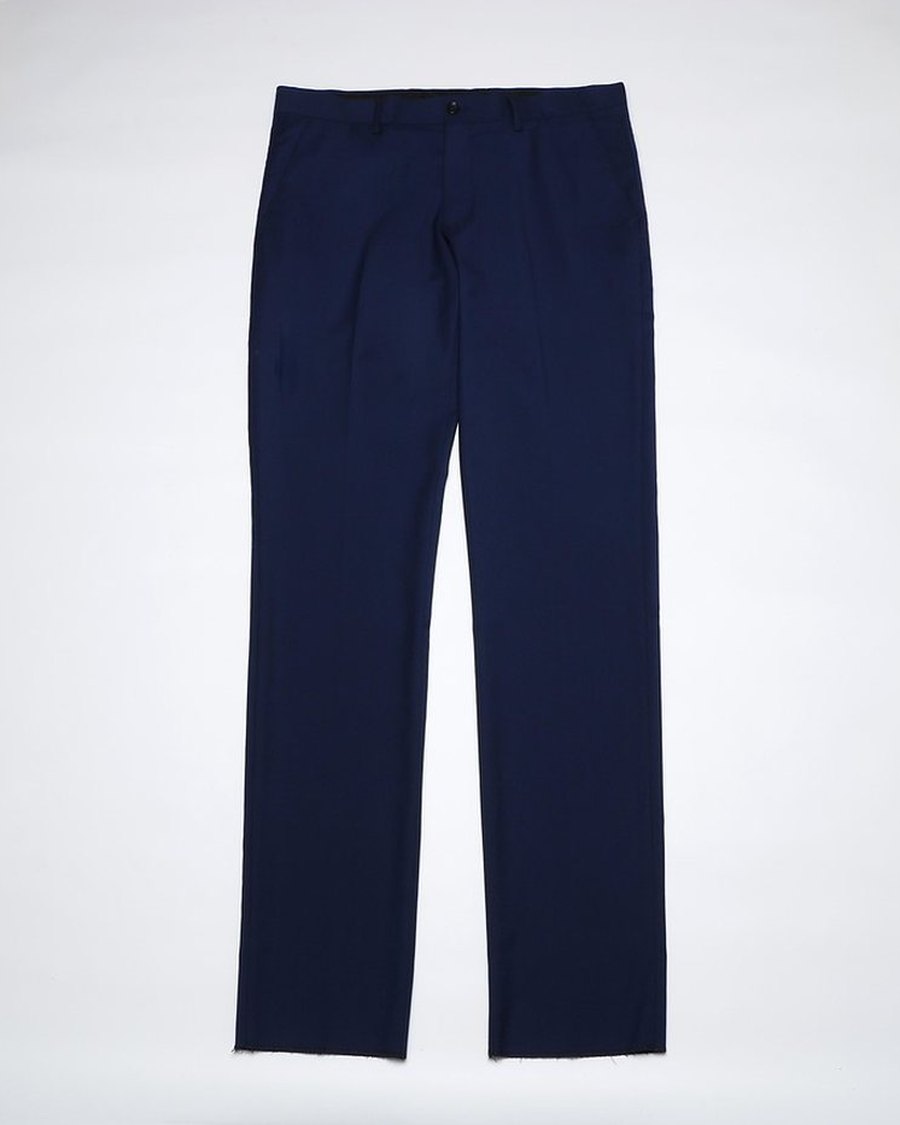
Three straight-leg trousers, three different ideas of the word. One is fully lined wool with a high rise and no figure attached to it. One is a washable stretch twill with an 11-inch rise and a published hem. One is a mid-rise wool blend with button tabs at the waist. Only one of the three pages states the leg opening, which is the measurement that decides what shoe fits underneath.
Three pages, three different sets of numbers
The Quince page gives fiber, lining, inseam and care, and calls the rise high without quantifying it. The J.Crew page gives fiber, rise, inseam, leg opening and care, which is every number needed to order without asking. The Everlane page gives fiber, rise, inseam, lining and care, but no leg opening, and did not show a USD price when checked.
That pattern matters more than any single figure. A shopper can compare three trousers on fiber percentage all day and still not know whether a shoe will fit under the hem. The numbers that go missing are the ones that generate returns: rise, leg opening and hem allowance. Every one of them can be measured on a pair you already own, which is the argument for doing that before ordering rather than after.
Rise: 11 inches, 10.125 inches, and a word
J.Crew publishes 11 inches on the Kate and calls it high-rise. Everlane publishes 10.125 inches on the Tailor Twill. The difference is seven eighths of an inch, which is smaller than the variance between two brands’ measuring methods, so treat the two as effectively the same height and judge them on the waistband instead.
Front rise is measured from the crotch seam to the top of the waistband. Some brands measure from the seam where the fly meets the inseam, some from the crotch seam itself, and some include the waistband in the figure while others stop below it. Half an inch of disagreement is normal. That is why the rise figures worth comparing are the ones you take off a pair that fits, laid flat and measured the same way twice.
Quince’s silence is the bigger problem. High-rise in the women’s market usually means 10 to 12 inches, but the category has no standard and no enforcement. This pair also has an elastic back panel, which changes the arithmetic: an elastic back can expand an inch or more over the seat, so the front rise can be cut shorter than the label implies and still be sold as high. On a long torso that combination is the one most likely to sit below the natural waist, which is where a tucked shirt starts to work loose.
Leg opening, and how to take the measurement yourself
Only J.Crew publishes one: 15.75 inches on a size 6. Leg opening is the circumference of the hem, taken flat and doubled, and it grades with size — the same cut on a size 12 will be wider, by how much varies by brand. That makes a single published figure a starting point rather than a specification, unless you happen to wear the sample size.
15.75 inches is a classic straight leg. It clears a loafer, an ankle boot and a derby without stacking, and it stops short of the volume that reads as a wide leg. Under about 14 inches the leg starts to taper and catches on a boot shaft; above 18 inches it becomes a different garment with different shoe requirements. The leg opening range that governs shoe volume is the more useful reference when a page publishes nothing, because it lets you measure a hem you already own and compare.
The other half is inseam. A trouser with a 15.75-inch opening and a 30-inch inseam falls straight; the same opening with a 26-inch inseam reads cropped. Neither number means much alone, which is why the two pairs here without a published opening are also the two where the photograph has to do the work.
Wool content against the care label
The three sit at 96 percent wool, 52 percent and 0 percent, and the care labels follow the fiber rather than the price. The Quince pair is dry clean only and fully lined. The Everlane pair is 52 percent wool, 46 percent recycled polyester and 2 percent elastane, half lined, machine wash cold and line dry. The J.Crew pair is 67 percent recycled polyester, 28 percent viscose and 5 percent elastane, unlined and machine washable.
Wool content predicts crease recovery, not warmth. Wool fibers have a natural crimp that lets the cloth spring back after a day of sitting, which is why a wool trouser looks pressed at six in the evening and a polyester one looks tired. The trade is care: a dry-clean trouser worn twice a week will need cleaning three or four times a season, and each clean is a small cost and a small amount of wear. A machine-washable blend avoids that, at the price of shine at the seat, where friction flattens the fibers and the light catches them differently.
Elastane is the other variable. Five percent is a lot for a trouser; it gives the fabric recovery, which is why the Kate holds its shape through a week, but it also means the garment relaxes slightly with body heat and resets in the wash. Heat is the enemy of elastane, so a tumble dryer shortens the useful life of the stretch whatever the care label permits. The 2 percent pair has less of both effects: less recovery, less relaxation.
The hem allowance nobody publishes
None of the three states how much cloth is folded inside the hem, and that number decides whether a trouser can be let down or only taken up. A deep turn-up gives a tailor something to work with; a shallow one makes the hem a one-way alteration. The only reliable check is to turn the hem up in a fitting room, or to ask, and to assume one-way until told otherwise.
The cost of getting this wrong is asymmetric. Shortening is cheap and reversible within the turn-up. Lengthening is limited by the cloth inside and leaves a line where the old hem sat. A 30-inch inseam on a shorter wearer is a routine hem; the same 30 inches on someone who needs 32 is a return, unless the turn-up is unusually deep. The alterations worth paying for begin with a hem that has room to move.
The Quince Italian Wool Straight Leg Pants
At USD 99.90, this is the only fully lined pair of the three and the only one that is 96 percent wool. The 4 percent elastane keeps the cloth from feeling brittle, and the elastic back panel makes the seat forgiving in a way a fixed waistband is not. The inseam is 30 inches, the longest here, and the rise is high with no number attached.
The lining changes how the trouser behaves. It slips over tights rather than gripping them, which keeps the knee from bagging, and it adds warmth that a half-lined pair does not have. It also means the whole garment goes to the dry cleaner, and a wool lining takes longer to dry than the shell. For a week of desk work in a cool office, that is a fair trade. For a warm commute, it is not.
It does not suit anyone who wants to wash their trousers at home, and it does not suit a long torso that needs a quantified rise before buying. The elastic back is the workaround: it will give over the hip, so the waistband sits where the front rise puts it rather than where the label suggests.
The J.Crew Kate straight-leg pant in four-season stretch
At USD 138, the Kate is the most documented pair here: 67 percent recycled polyester, 28 percent viscose, 5 percent elastane, an 11-inch high rise, a 28-inch inseam, a 15.75-inch leg opening on a size 6, unlined and machine washable. The product page carries a 4.6 rating from 365 reviews, a large enough count to be worth reading rather than skimming.
The 28-inch inseam is the shortest of the three, which makes it the pair most likely to work off the rack on a shorter wearer and the one most likely to need a deep hem or a return on a taller one. The 5 percent elastane is the highest stretch content here and does most of the work: the trouser moves with a desk day and recovers in the wash, and it will not crease the way wool does.
It does not suit anyone who wants a natural-fiber trouser, and the synthetic blend will develop a sheen at the seat with enough wear. The unlined construction makes it the coolest of the three in summer and the least warm in winter, which is the honest meaning of four-season.
The Everlane Straight-Leg Trouser in Tailor Twill
The Tailor Twill is 52 percent wool, 46 percent recycled polyester and 2 percent elastane, half lined, with a 10.125-inch front rise and a 30-inch inseam. The US page did not show a USD price when checked, so the price is not listed here. Button tabs at the waist allow adjustment without a belt, which is useful on a trouser bought for a tuck.
The 10.125-inch rise is the lowest of the three and the easiest to wear with a shorter top. On a standard build it sits just below the natural waist; on a long torso it sits at the hip, and a full tuck will not hold through a day of sitting. The half lining covers the front to the knee, which is enough to stop the thigh catching and not enough to make the trouser warm.
The blend is the compromise the other two avoid: more wool than the Kate, less than the Quince, washable but not as forgiving as the synthetic. It will crease less than pure wool and more than polyester, and it will need pressing at the hem after washing to keep the line. It does not suit anyone who needs the rise quantified to the eighth of an inch before ordering, since the fit depends on where that 10.125 lands on the body.
Which pair for which week
For a formal week and a tuck, the Quince pair: highest wool content, fully lined, longest inseam, and a waistband that gives over the hip. Accept the dry cleaning and the unquantified rise. For a desk week with a train commute and no iron, the Kate: the published leg opening is the only one you can check against your own shoes before ordering, and the 28-inch inseam suits a flat. For a shorter top and a waistband that adjusts, the Tailor Twill, provided the 10.125-inch rise lands where you need it.
The group cannot do three things. None is a wide leg, so none will substitute for a wide-leg trouser when the outfit needs volume at the hem. None combines a high wool share with machine washing: the closest is the 52 percent blend, which still asks for line drying and pressing. And none publishes a hem allowance, so all three carry the same one-way risk at the tailor. The heavier work-trouser end of the category turns on the same three numbers, and there rise and hem width diverge faster than fiber content.
The shortlist
What we would pick
Some links below are affiliate links — we may earn a commission at no extra cost to you.
The comparison separates a dry-clean wool trouser, a washable stretch straight leg and a mid-rise wool blend. Rise and leg opening predict the outfit more reliably than wool percentage, and only one of the three publishes both numbers. The Quince pair is the formal option, the J.Crew pair is the washable workhorse with the only verifiable hem width, and the Everlane pair is the lowest rise for a shorter top. None of them publishes a hem allowance, so all three carry the same risk at the tailor.
- Range compared
- 3 trousers, USD 99.90-138 where listed
- Rise
- 10.125-11 in, one unquantified
- Leg opening
- 15.75 in, one published
- Wool content
- 0-96%
Italian Wool Straight Leg Pants
USD 99.90Quince
A fully lined straight-leg trouser in 96% virgin Italian wool with 4% elastane, made in Sri Lanka, and the only pair here that is dry clean only. The waist has an elastic back panel, which is unusual on a wool trouser and makes the seat more forgiving, though it also means the front rise can be cut shorter than the label implies. The rise is described as high but no measurement is published, and the 30-inch inseam is the longest of the three. The full lining slips over tights and adds warmth, and it sends the whole garment to the dry cleaner rather than half of it. It suits a formal week and a tuck, and it does not suit anyone who wants to wash trousers at home or needs a quantified rise before ordering.
- Fabric
- 96% virgin wool, 4% elastane
- Rise
- High-rise; number not published
- Inseam
- 30 in
- Lining
- Fully lined
- Care
- Dry clean only
Kate straight-leg pant in four-season stretch
USD 138J.Crew
A machine-washable straight leg in 67% recycled polyester, 28% viscose and 5% elastane, with an 11-inch high rise and a 28-inch inseam. It is the only pick that publishes a leg opening: 15.75 inches on a size 6, which clears a loafer or an ankle boot without reading wide. The 5% elastane is the highest stretch content here; it gives recovery through a desk week, relaxes slightly with body heat and resets in the wash, and heat degrades it, so a dryer shortens its useful life. It is unlined, which makes it the coolest of the three in summer and the least warm in winter. The synthetic blend holds shape but develops sheen at the seat, and it does not suit anyone who wants a natural-fibre trouser.
- Fabric
- 67% recycled polyester, 28% viscose, 5% elastane
- Rise
- 11 in
- Inseam
- 28 in
- Leg opening
- 15.75 in (size 6)
- Care
- Machine wash
Straight-Leg Trouser in Tailor Twill
Everlane
A half-lined trouser in 52% wool, 46% recycled polyester and 2% elastane, with a 10.125-inch front rise and a 30-inch inseam. Button tabs at the waist allow adjustment without a belt, which helps on a trouser bought for a tuck. The half lining covers the front to the knee: enough to stop the thigh catching, not enough to make the trouser warm. It is machine wash cold and line dry, but the wool share means it needs pressing at the hem after washing to keep the line. It is the lowest rise of the three and the easiest to wear with a shorter top, and it does not suit a full tuck on a long torso. The US page did not show a USD price when checked, so no price is listed here.
- Fabric
- 52% wool, 46% recycled polyester, 2% elastane
- Rise
- 10.125 in
- Inseam
- 30 in
- Lining
- Half lined
- Care
- Machine wash cold, line dry
| Specification | Quince Italian Wool | J.Crew Kate | Everlane Tailor Twill |
|---|---|---|---|
| Price | USD 99.90 | USD 138 | Not listed in USD |
| Wool content | 96% | 0% | 52% |
| Rise | High-rise, not published | 11 in | 10.125 in |
| Inseam | 30 in | 28 in | 30 in |
| Leg opening | Not published | 15.75 in (size 6) | Not published |
| Lining | Fully lined | Unlined | Half lined |
Where these numbers come from
Frequently asked
- What rise works with a tucked shirt?
- A rise that meets the shirt hem without a gap, usually 10 to 11 inches on a standard build. Higher rises read more formal and hold a tuck better; lower rises need a shorter shirt or a belt to close the line.
- Is a 15-inch leg opening wide?
- It is a straight leg, not a wide leg. On a size 6, 15 to 16 inches reads as a classic straight trouser. Anything above 18 inches starts to read as a wide leg and changes which shoes fit underneath.
- Can stretch trousers be hemmed normally?
- Yes, but the hem should be sewn with a slight stretch stitch or left with a small amount of ease. A tight, non-stretch seam on a 5% elastane fabric can pucker. Ask the tailor to press the hem rather than stretch it.