The layer report · Knitwear & Layers
Why Expensive Wool Still Pills
Why an expensive wool sweater still pills: staple length, yarn twist and abrasion, and what Woolmark says actually reduces pills.
A $40 merino crewneck and a $400 cashmere crewneck can both pill at the underarm inside a month. Price buys softness, color and finishing; it does not buy abrasion resistance. The variables that decide pilling are set at the mill, before the garment reaches a shelf, and most of them never appear on a label.
What a pill is made of
A pill is a knot of fibers that has worked loose from the yarn, tangled with its neighbors and stayed anchored to the surface. It forms in three stages: fuzz rises out of the yarn, fibers from adjacent loops interlock, and the tangle grows until it either breaks off or holds.
That sequence explains why pilling concentrates where the cloth is rubbed rather than where it is worn thin. Woolmark puts the worst areas at the elbows, underarms, sleeves and sides, which are the points that meet a desk, a bag strap, a seatbelt or the body itself. A pill that breaks away leaves a cleaner surface behind. One that stays attached keeps collecting, and the patch around it looks worse than the pill.
Fuzz on a new knit is normal and usually sheds. A pill field that reappears two wears after every de-pilling is a property of the yarn, not of the care.
Staple length sets the number of loose ends
Staple is the length of the individual fiber before spinning, measured in millimeters on a wool specification. A long staple has fewer fiber ends in a given length of yarn. Fewer ends means fewer loose tips available to migrate out of the surface, which is the first stage of the pill.
Woolmark’s spinning guidance is direct: too short a fiber length can lead to poor performance such as pilling in knitwear, and longer fibers are used where a smoother, stronger yarn is needed. The number is a mill specification. It is not printed on a hangtag, which is why two sweaters labeled 100 percent merino can behave differently at the cuff. Four merino sweaters compared shows how far the fiber spec varies behind the same fiber name.
The hard case is cashmere, where the fiber is fine and the staple short, commonly 30 to 45 mm in mill specifications. Fine fibers need more of them in a yarn cross-section to reach a given thickness, so there are more ends per centimeter. A cashmere knit works against the mechanism from the first wear, however good the fleece.
Twist is what holds them in
Twist is the number of turns per inch put into the yarn, usually quoted as a twist factor so that yarns of different thicknesses can be compared. Twist presses the fibers against each other and increases friction between them, so a tightly twisted yarn grips its fibers and resists migration.
Woolmark lists three design levers against pilling: use longer fibers, use the highest twist factor the intended handle will tolerate, and use fabrics with a higher cover factor. Twist is the middle one, and it is a trade. High twist gives a firmer, drier hand and a clearer stitch. Low twist gives loft, softness and a halo, which is why the softest sweater in a shop is often the one most likely to pill.
Ply sits alongside twist. A two-ply yarn has fibers twisted into a single and then singles twisted together, which adds a second layer of binding; a single relies on one set of turns. A soft-spun single in a loose gauge is the combination that pills fastest.
Cover and gauge decide where the rub lands
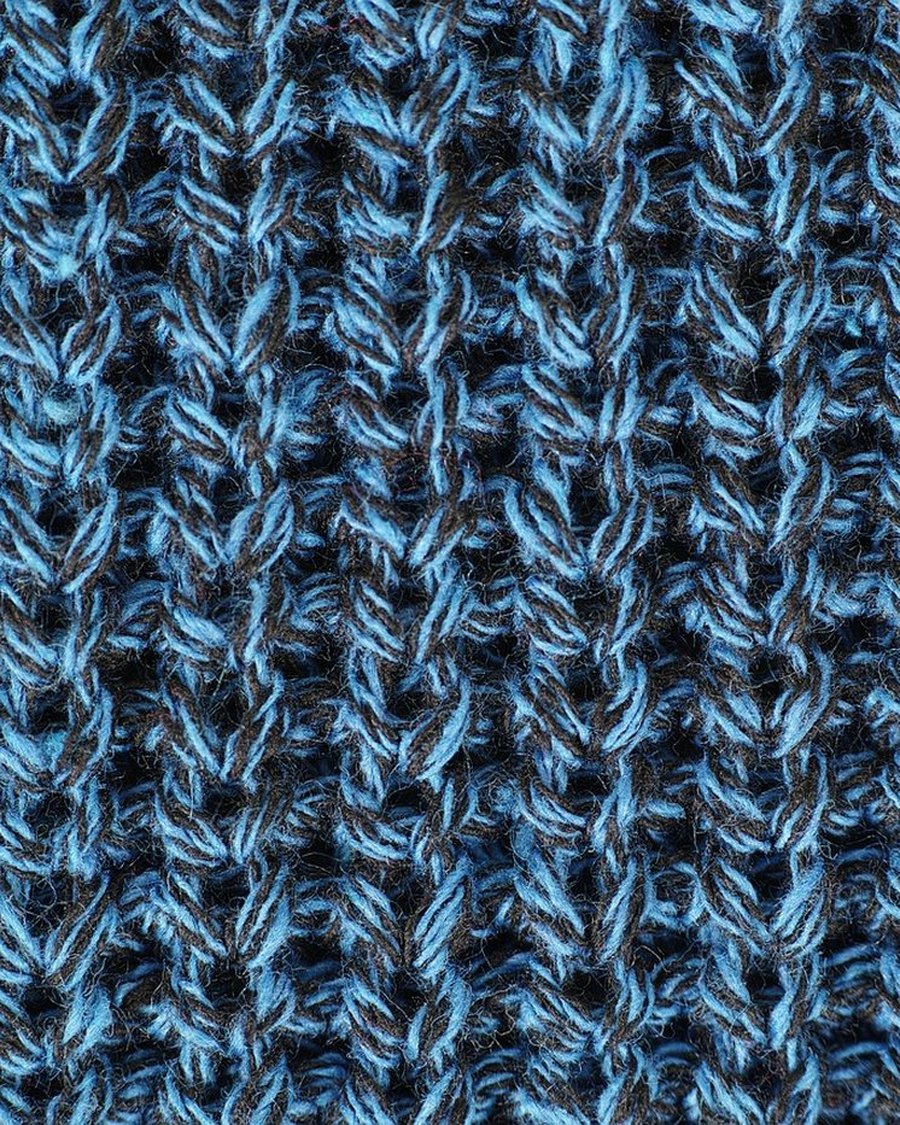
Cover is how completely the yarns fill the fabric surface. In a loose, open knit the crowns of the loops stand proud, and a few high points absorb all the abrasion from a bag strap; in a tight one the surface is flatter and the load spreads.
This is the same mechanism that makes a fine gauge wear better at the elbow than a coarse one. Coarse stitches present larger, softer crowns with more surface fiber, while a tight gauge and a flat stitch hold the fibers in a denser plane. Gauge narrows the odds without settling them: a 14-gauge soft-spun cashmere can still pill before a 7-gauge tightly twisted lambswool. Gauge from 3 to 14 covers the scale.
Why price does not predict it
Money in a knit buys fiber fineness, color depth, hand-finishing, the country of manufacture and the reputation of the mill. None of those is the same as abrasion resistance. Fineness in particular works the other way: finer fibers feel better against skin and are, for the same staple length, more prone to migrating.
Brands also choose softness over durability because softness is what sells in a shop, and pilling is what happens in month two. A mill can spin a yarn that pills far less, and the sweater made from it will feel crisp and slightly dry in the hand. Most customers put that sweater down.
So the price signal is weak in both directions. An expensive soft-spun cashmere can pill in the first weeks and then settle, because the loose fibers work out and the surface stabilizes. A cheap blend can keep producing pills indefinitely, because the short fibers in it never stop migrating and the yarn never grips them. What a composition percentage implies narrows the guess, but staple and twist are still hidden.
The first month tells you which kind you have
Watch the rate rather than the presence. Pills that appear in the first two or three wears at the underarm and then reduce are the normal settling of a new knit; the surface is shedding the fibers that were never fully bound. Pills that return at the same density after every de-pilling, and spread to low-friction areas such as the chest and upper sleeve, point to construction.
A second signal is location symmetry. Wear at both underarms is friction. Wear across the whole front is the cloth. How a knit recovers covers the related question of shape, which fails on a similar timeline and for some of the same reasons.
Care that changes the rate
Wash the garment inside out, which puts the abrasion of the drum or the basin on the inside face, and skip fabric softener. Softener leaves a film on the fiber that reduces friction between yarns, and friction is what keeps loose ends inside the cloth. Wash less often; a sweater over a shirt can go eight to ten wears between washes with airing in between.
De-pill with a comb or a shaver on a clean, flat, dry garment, using light passes and stopping before the surface thins. Pulling a pill that is still attached lifts more fiber with it and enlarges the problem. Woolmark’s position is that nobody can guarantee pilling will not occur, so the aim is management rather than elimination.
Reading a knit at the rail
Hold the garment up to the light. A heavy halo of loose fiber around the surface is the raw material for pills, and a dense, flat, slightly crisp face is not. Rub the cloth briskly between finger and thumb and look for fibers lifting immediately; a yarn that releases fuzz under light pressure will do the same under a bag strap.
Then read the label for what the tag does disclose: gauge, ply and the blend. A 100 percent cashmere at a third of the price of another is not automatically worse, but it is more likely to be short-staple and loosely spun. The reliable test is the hand: a knit that feels firm and dry outlasts one that feels like a cloud, and the difference shows at the underarm first.
Frequently asked
- Does pilling mean the wool is poor quality?
- Not on its own. Woolmark notes that pilling depends on abrasion, fiber length, twist and fabric cover, and that no one can guarantee it will not occur. Localized pills at the underarm say more about friction than about the fleece.
- Will a fabric shaver damage a knit?
- It can if pressed hard or used repeatedly on the same spot. Use a comb or shaver lightly on a clean, flat garment, and stop before the surface thins. Never pull a pill that is still attached.
- Do longer fibers always pill less?
- They give fewer loose ends to tangle, which is why Woolmark lists longer fibers among the design levers against pilling. Twist and cover still matter, so a long-fiber yarn spun slack can pill more than a shorter, tightly twisted one.