The layer report · Knitwear & Layers
Three Cardigans Compared by Closure and Gauge
Three cardigans compared on closure type, gauge, micron and care, and what a zip or a button front does to the way the front hangs when open.

A cardigan is judged open more often than closed. That makes the closure more than a fastening: it sets the width of the centre front, how the collar sits when the front is undone, and whether the two panels hang parallel or swing apart. Gauge then decides how much of that the knit can hold without a seam to help it, and the two numbers together explain why one cardigan reads as a jacket and another as a robe.
A cardigan is judged open
Open, a cardigan is a vertical line on each side of the body, and everything about how it reads comes from those two edges. A stiff edge stays where it is put and frames a shirt. A soft edge rolls toward the body and closes the front even when the buttons are undone. Neither is better; they are different garments, and the closure plus the stitch decide which one you get.
The neckline is the second half of the same question. A V-neck with a button front opens wider as the top button comes undone, which lengthens the neck but shows more shirt. A collar with a zip closes to the throat and reads as outerwear. That is why the three cardigans here cannot be swapped one for another in the same outfit, even though all three are merino.
Length is the third variable, and it is the one that decides the trouser. A cardigan that ends at the hip puts a horizontal line exactly where a high waistband sits, so the two hems compete. One that ends below the hip covers the waistband and makes the leg read longer, at the cost of hiding the rise you paid for. Check the body length against the rise of the trousers you wear most before choosing a closure, because the same cardigan can look deliberate over one pair and accidental over another.
What a zip fixes, and what it costs
A zip joins the two fronts along a continuous track, so the panel edges stay aligned whether it is closed, half-closed or open at the bottom. That is a real advantage on a thick knit, where a soft front would otherwise swing apart. A two-way zip adds a second slider at the hem, which lets the bottom of the cardigan open over a high-rise trouser instead of bunching above the waistband.
The cost is visible. The tape runs down the centre front as a flat, contrasting line, and the front cannot lie completely flat when open because the tape has no drape. On a 5-gauge knit the zip is also heavy: it pulls the neckline forward when the cardigan is worn open, and it can ripple the front if the knit is not blocked squarely.
Where a button front fails
Buttons leave the edge soft. Closed, the placket overlaps and the knit carries the tension; open, the front edges curl according to the stitch. A ribbed or Milano-stitched front holds a straighter line than a plain jersey one, which is the difference between a cardigan that frames a shirt and one that collapses toward it.
The failure is the gap between buttons at the chest. That gap is not caused by the closure; it is caused by the chest measurement of the garment being close to the body, which puts the placket under horizontal tension. Sizing up changes the gap more than switching to a zip does, and button spacing matters too: buttons set far apart leave a longer unsupported edge between them, and that edge is what opens.
Buttonholes are the other failure point, and they fail slowly. A knit buttonhole stretches with use, so a cardigan that closes cleanly in the shop can gap by the second winter. Moving a button outward by a quarter inch is a ten-minute repair and cheaper than replacing the garment, which is worth knowing before a loose placket is read as a fit problem.
Gauge: 5, 12 and unpublished
Gauge is needles per inch, so it runs opposite to thickness: 5 gauge is a thick, chunky knit, 12 gauge is a mid-weight one, and 16 gauge is thin enough to layer under tailoring. The three cardigans here sit at 5, at 12, and at a figure Uniqlo does not publish.
At 5 gauge the fabric is thick enough that the front edge has its own body; the knit does not need a ribbon or a facing to stop it curling. At 12 gauge, structure comes from the stitch rather than the yarn, which is why a Milano knit holds a straight front and a plain fine-gauge jersey cardigan does not. The finer the gauge, the more the front depends on the stitch and the placket: a 16-gauge button cardigan in plain jersey will ripple along the button line after a season, while the same gauge in rib or Milano will not.
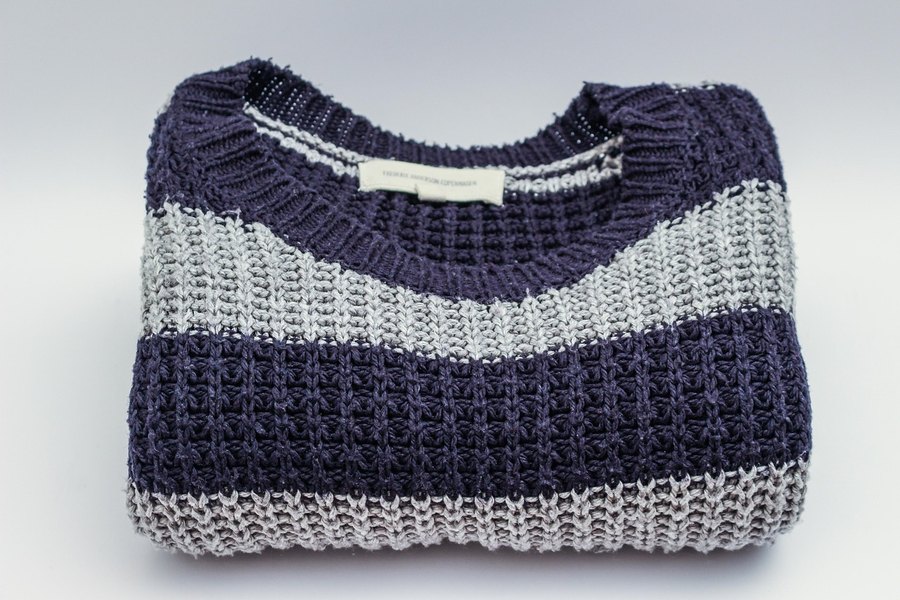
Knit gauge in an office covers the same question for pullovers, where the constraint is a jacket sleeve rather than a front edge.
The zip cardigan: Quince full zip
The Australian Merino Wool Full Zip Sweater from Quince is USD 102 in 100 percent Australian merino, listed at 19.5 micron and 5 gauge, with an allover fisherman rib and a two-way YKK zipper. The two-way zip is the useful part: it opens from the hem as well as the neck, which changes how the cardigan sits over a high-rise trouser and lets the front fall in two clean panels when it is worn open.
At 5 gauge the knit is thick, and Quince’s care instruction is hand wash cold, inside out, flat to dry. That is the cost of the weight: a sweater this size takes a day and a half to dry flat and cannot be hurried, and it needs a surface larger than a towel on a radiator. It is a layer to wear instead of a jacket, and it does not work under a coat, where the zip, the rib and the thickness together drag at the shoulder.
The structured button front: Quince crochet trim
The Australian Merino Wool Crochet Trim Sweater Jacket from Quince is USD 100, also 100 percent Australian merino at 19.5 micron, but at 12 gauge with an allover Milano stitch, a collar, horn-style buttons and hand-crocheted trim. Milano stitch is a denser, more stable structure than jersey, which is what lets the front stand instead of collapsing.
This is the one that behaves like a jacket. The collar gives the neckline a defined edge, the patch pockets add weight low down, and the buttons close it into a standalone top, so it can be worn over a shirt with nothing else. The crocheted trim is the part to protect: it snags on a bag strap and on a coat lining, and it cannot be repaired invisibly. It is hand wash only, and at 12 gauge it will not pack as small as a fine-gauge cardigan.
The machine-washable one: Uniqlo
The Merino Cardigan V-Neck from Uniqlo is USD 49.90, 100 percent wool at 19.5 micron, machine washable, with a variable rib at the sleeves and hem that the brand says prevents sagging. Uniqlo does not publish a gauge for it, which is the main gap in the comparison: the weight can only be judged in the hand.
It is the cheapest entry point for a merino cardigan, and the care exception. This is the only one of the three that can go in a machine on a cold gentle cycle, in a mesh bag, and that changes how often it will be worn, because a cardigan’s front edge is handled every time it is put on. The block is cut unisex, so the shoulder runs wider than a women’s cardigan at the same alpha size; the sleeve length is worth checking against a sweater you own. Shoulder seam placement explains what that does to the line at the top of the arm.
What the front edge does after a season
The front edge is the part of a cardigan that wears first, because it is gripped, pulled and buttoned every time the garment is worn. A ribbed or Milano edge has enough structure to return; a plain jersey edge stretches along the button line and stays stretched. That is why the stitch matters more here than on a pullover, where the neckline takes the handling instead.
Storage decides the rest. A knitted cardigan on a hanger grows at the shoulder and at the top of the front panel, and the stretch does not come out with washing. Fold it, and rest it a day between wears so the fibre can return to its shape. How a knit recovers sets out why wet wool and gravity are the two things to avoid, and why a tumble dryer is never the answer for any of these three.
Washing is a space problem as much as a care problem. A 5-gauge cardigan holds a lot of water, so it needs a bath, a clean towel to press the water out, and a flat surface big enough to dry it without creasing. That is a two-day operation in a small flat, which is the honest reason a thick cardigan gets washed twice a season rather than twice a month.
Which jacket each one replaces
The 5-gauge zip replaces a fleece or a light chore coat: it is the one to wear outdoors over a shirt in autumn, with the hem open over a high rise. The 12-gauge Milano button front replaces a soft blazer: it has a collar, pockets and enough structure to wear to an office, and it costs less to clean than a jacket but more to replace. The Uniqlo V-neck replaces nothing in particular, which is its appeal: it is the cardigan to keep at a desk and wash without ceremony.
Choose the closure before the colour. A zip cardigan and a button cardigan do different things to the same outfit, and no amount of styling makes a soft button front behave like a zipped track when the front is worn open.
The shortlist
What we would pick
Some links below are affiliate links — we may earn a commission at no extra cost to you.
Three merino cardigans that differ mainly in how they close and how thickly they are knitted. The Quince full zip is the outerwear option at 5 gauge, the Quince crochet trim jacket is the structured button front at 12 gauge, and the Uniqlo V-neck is the machine-washable entry point at 19.5 micron. Choose the closure first, because it decides how the front behaves when the cardigan is worn open. What the group cannot settle is yarn structure: none of the three publishes ply, and the Uniqlo gauge is missing, so two of the three fronts have to be judged in the hand.
- Range compared
- 3 cardigans, USD 49.90-102
- Fibre
- 100% merino in all three
- Key specs
- Closure type and gauge
- Best for
- A layer worn instead of a jacket
Australian Merino Wool Full Zip Sweater
USD 102Quince
100% Australian merino at 19.5 micron and 5 gauge, with an allover fisherman rib and a two-way YKK zipper that also opens from the hem. Quince specifies hand wash cold, inside out, and flat drying, which is the cost of the weight: a garment this thick takes a day and a half to dry and needs a surface large enough to lay it flat. The zip holds the two fronts in line at any opening, and the second slider lets the hem open over a high-rise trouser instead of bunching above it. The tape adds a visible centre line and stops the front lying flat when open, which is the trade for that alignment. It is a layer to wear instead of a jacket, not under one, where the rib and the zip drag at the shoulder. It suits a cold commute and a relaxed line; it does not suit anyone who wants a cardigan that disappears under a coat.
- Fabric
- 100% Australian merino wool
- Micron
- 19.5
- Gauge
- 5
- Closure
- Two-way YKK zip
- Stitch
- Fisherman rib
- Care
- Hand wash cold, flat dry
Australian Merino Wool Crochet Trim Sweater Jacket
USD 100Quince
100% Australian merino at 19.5 micron and 12 gauge, knitted in an allover Milano stitch that gives the front enough body to stand on its own. It has a collar, horn-style buttons, hand-crocheted trim and functional patch pockets, and Quince positions it between a cardigan and a jacket. The structure is the reason to choose it: Milano is denser than jersey, so the placket holds a straight line and the collar keeps an edge when the front is open. Hand wash only, and the crocheted trim is the fragile part, since it snags on bag straps and coat linings and cannot be repaired invisibly. It will not pack as small as a fine-gauge cardigan, and it does not suit anyone who wants a soft, collapsible layer for travel.
- Fabric
- 100% Australian merino wool
- Micron
- 19.5
- Gauge
- 12
- Closure
- Horn-style buttons
- Stitch
- Milano, hand-crocheted trim
- Care
- Hand wash cold, flat dry
Merino Cardigan V-Neck
USD 49.90Uniqlo
100% wool at 19.5 micron, machine washable in a mesh bag, with a variable rib at the sleeves and hem that Uniqlo says prevents sagging. It is the only one of the three that can go through a machine, which matters more for a cardigan than for a pullover because the front edge is handled every time it is worn. Gauge is not published, so the weight and the front's stiffness have to be judged in the hand rather than read off a page. The block is unisex, so the shoulder runs wider than a women's cardigan at the same alpha size and the sleeve length is worth checking against a garment you own. It is the lowest-risk buy of the three for a first merino cardigan and the least structured when worn open.
- Fabric
- 100% wool
- Micron
- 19.5
- Gauge
- Not published
- Closure
- Button front, V-neck
- Fit
- Unisex sizing
- Care
- Machine wash cold, gentle cycle
| Specification | Quince Merino Full Zip | Quince Crochet Trim Jacket | Uniqlo Merino Cardigan |
|---|---|---|---|
| Price | USD 102 | USD 100 | USD 49.90 |
| Closure | Two-way YKK zip | Horn-style buttons | Button front |
| Gauge | 5 | 12 | Not published |
| Micron | 19.5 | 19.5 | 19.5 |
| Fibre | 100% Australian merino | 100% Australian merino | 100% wool |
| Stitch | Fisherman rib | Milano | Not published |
| Care | Hand wash cold | Hand wash cold | Machine wash cold |
Where these numbers come from
Frequently asked
- Is a zip cardigan warmer than a button cardigan?
- At the same gauge and fibre, a zip closes the front without gaps, so it holds warmth along the centre line. A button front leaves small openings between buttons and a wider neck opening. The difference is real but smaller than the difference between a 5-gauge and a 12-gauge knit.
- Why does a button cardigan pull open at the chest?
- Because the front edge has no structure to resist tension. A buttoned knit at a tight gauge carries the strain on the placket, and if the chest measurement is close to your body the buttons gap. Sizing up changes the gap more than changing the closure does.
- Should a cardigan be hand washed?
- Follow the label. Both merino cardigans here specify hand wash cold and flat drying, and Woolmark advises flat drying for all knitwear because hanging a wet sweater stretches it. A machine-washable knit is the exception, not the rule.