The denim ledger · Denim & Trousers
Black Trousers and Navy Trousers Are Not Interchangeable
Navy keeps a blue cast and black removes color entirely. How dye depth, fading and shoe color decide which of the two dark trousers belongs.

Black and navy are both dark, both neutral, and both sold as the safe trouser. Side by side in daylight they behave differently. Navy keeps a blue cast that softens the edge of the garment and shows its texture; black removes color altogether and leaves only shape. That difference decides which shoes, tops and layers each one accepts, and it decides which one will still look right after two years of washing.
Two darks, two values
Value is the first difference and the easiest to see. Navy sits two or three steps lighter than black on a gray scale, which is enough that a navy trouser still shows a crease, a twill line and the shadow of a pocket, while a black one collapses into silhouette in low light. In a bright room the gap narrows; at night it widens.
That has a practical consequence. A crease that reads clearly on navy reads as a faint line on black, so a black wool trouser depends more on fit and less on pressing. Black also hides construction detail — an uneven hem, a gaping pocket — while navy exposes it.
Neither is more formal in the abstract. Navy is the daylight business default in most offices; black is the evening and urban one, and the rule that black is dressier comes from evening dress, not from cotton twill.
How black gets its depth
Black on cotton is usually a sulfur dye, applied in a reduced soluble form and then oxidized on the fibre, or a reactive dye that bonds chemically to the cellulose. Sulfur black is loaded heavily and sits near the surface, which is why a new pair crocks onto pale shoes, light upholstery and the inside of a bag. Reactive black penetrates more evenly and crocks less, but costs more and is less common at low price points.
Depth on black comes from dye concentration, not a darker pigment, and the dye is what fails first. Sulfur black continues to oxidize with air and washing, and the shade moves from neutral black toward charcoal with a brown or rust cast. The effect is strongest at seams, hem and seat, where abrasion exposes the most dye.
On wool, black is usually acid-dyed and penetrates well, giving an even color that resists fading but not mechanical damage: pressing and sitting polish the fibre surface, and black wool develops shine at seat and knee faster than any other color because no color variation disguises the change in reflection.
How navy gets its depth
Navy is a range, not a color. On cotton it may be indigo, ring-dyed so the yarn stays pale at the core, or a reactive navy, which penetrates evenly and reads flatter. Indigo navy has depth because the surface is uneven; reactive navy because the shade is saturated. They age in opposite directions.
On wool, navy is acid-dyed and the color sits inside the fibre, so it wears gradually rather than abrading away in patches. A navy wool trouser generally holds its color longer than a black cotton one.
The trap is that navy has a wider acceptable range than black. A navy that is almost black behaves like black in combination and like navy in fading; a bright navy reads as a color and needs different shoes. Product photographs are unreliable here: the same cloth looks near-black on one screen and royal on another.
How each one fades
Black cotton fades toward charcoal, then toward a brown-gray, and the change is uneven because abrasion is uneven. Knees and seats go first, then the hem, then the waistband where a belt rubs. A pair washed hot and dried often reaches the brown stage within a year, and home re-dyeing usually produces a flat, slightly purple black.
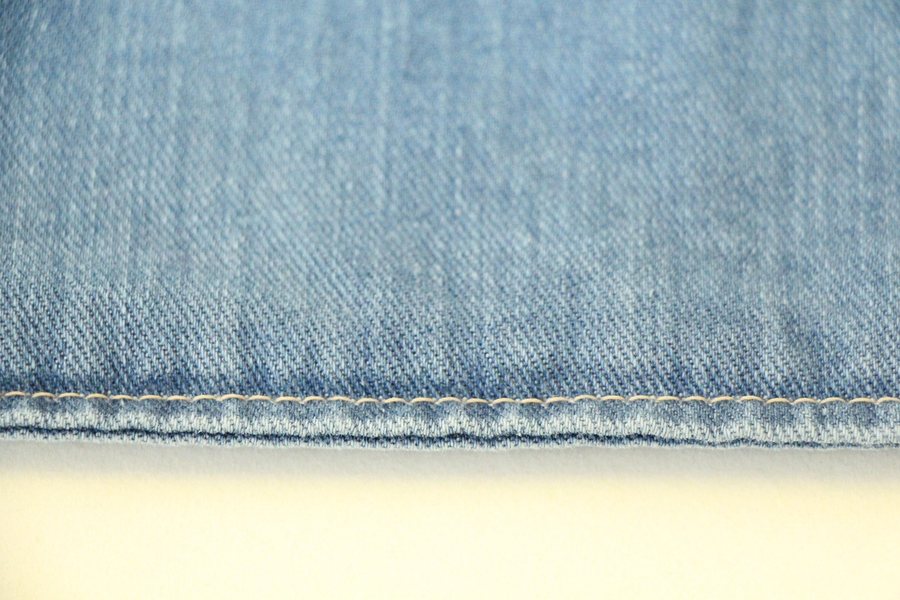
Navy cotton fades toward a lighter blue and does it more gracefully, because the blue cast was already there. Indigo navy develops the pale seam grin familiar from denim; reactive navy fades less but can drift toward purple or pink at exposed points, a known weakness of inexpensive reactive blues.
Navy wool fades by losing saturation, going toward blue-gray at the high points. Black wool does not fade so much as glaze: the fibre surface flattens where it is pressed, and the shine is a change in reflection rather than color. Steaming lifts some of it; nothing removes it fully. This is the strongest argument for navy in a trouser sat in five days a week.
What each accepts at the ankle
A black trouser over a tan shoe creates a hard horizontal at the ankle, which can look deliberate and usually does not. Black over black is a continuous line and the easiest pairing; black over dark brown works if the trouser is casual and the shoe is matte.
Navy over brown is a classic pairing and needs no defense. Navy also takes oxblood, burgundy, tan and cognac, which makes it the easier base for a wardrobe built on brown leather. Navy over black is harder than the reverse, because a black shoe under a navy trouser reads as a near-miss unless the navy is very dark and the shoe is sleek.
The same reasoning applies to volume. A wide black hem over a chunky black boot is a single mass; the same hem over a brown shoe splits the silhouette at the ankle. Building the outfit around one shoe sets out the method, and boots and trouser break covers the length question that decides whether the shoe is even visible.
What each accepts above the waist
Navy accepts brown, tan, camel, burgundy, olive, gray, cream and white. It is the more forgiving base for a wardrobe with warm colors in it.
Black accepts white, gray, denim, cream and black itself, and resists brown unless the brown is very dark. It is the better base for a wardrobe built on gray, white and silver, and the worse one for a wardrobe built on camel and tan.
Black and navy worn together need a separator: a gray knit, a white shirt, a visible difference in texture or a belt. Without one, the two darks read as an oversight. The proportions are covered in three-color outfits and monochrome proportions.
The decision rule
Count the shoes and the layers already in the wardrobe. A rail of brown, tan and cognac footwear points to navy. A rail of black boots, gray knitwear and white shirts points to black. If the wardrobe is split, buy navy first: it is the more versatile of the two in daylight, and it fails less visibly as it ages.
Then decide the second pair by job rather than color. A second dark in the same fabric weight is usually a waste, because it competes for the same outfits. Buy the one that answers a different shoe and a different hour: navy in a mid-weight wool for daytime, black in a heavier cotton or crepe for evening.
Two checks before the tags come off. Look at the trouser under the light you will actually wear it in, since navy shifts more than black between daylight and tungsten. And rub a thumb across the inside of the hem on a pale cloth: a gray mark means the black will crock for a month.
Frequently asked
- Can you wear black trousers with brown shoes?
- Yes, if the brown is dark and the trouser fabric is casual. A tan shoe under a black wool trouser creates a hard break at the ankle that reads as an error more often than a choice.
- Is navy more formal than black?
- In daylight tailoring, navy is the business default and reads slightly softer, while black reads more formal after dark and in city settings. Neither is universally dressier; the shoe and fabric weight decide.
- Why do my black trousers fade to brown?
- Sulfur black dye on cotton breaks down toward a brown or rust cast with washing and abrasion. Cold washing inside out and air drying slow the change without stopping it.