The office · Workwear
Bag Size Against Body Scale and Jacket Length
Bag dimensions in inches against torso length and coat hem, and why the same 15-inch tote reads as luggage on one person and not another.
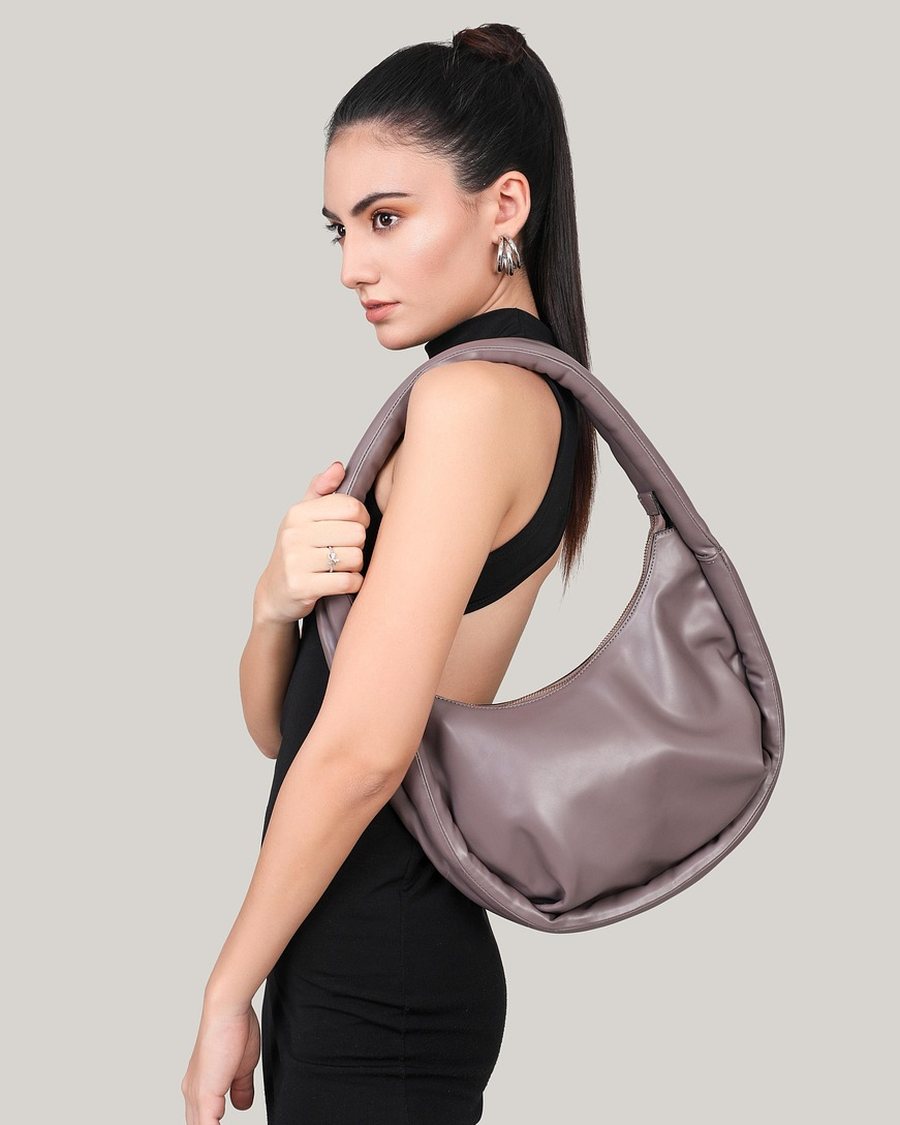
A tote is 15 inches wide, which is within an inch of the shoulder line of an average adult woman. That coincidence explains most of why the same bag reads as luggage on one person and as a bag on another. Two tape measurements settle it: torso length, and the hem of the coat you wear most.
Two numbers and one zero point
Bag proportions are usually discussed as if the bag had a size in isolation. It does not. A bag is a rectangle hanging from a fixed point on the body, and every question about it, whether it swamps the wearer or fights a coat, is a distance from that point.
The point is the high point of the shoulder, the bony ridge at the outer end of the collarbone. Published size charts measure coat lengths from there, and a bag’s bottom edge is found from there by adding strap drop to body height. Because both share a zero, they can be compared directly, which makes the coat rule arithmetic rather than taste.
Measuring torso length
Torso length here means the distance from the high point of the shoulder straight down to the natural waist, the narrowest part of the body above the hip. Adults commonly measure between 16 and 19 inches.
Three details decide whether the number is useful. The tape runs vertically, not along the curve of the chest, because a bag hangs in a straight line. The waist is located by bending sideways, since the crease that forms is the natural waist and usually sits an inch above the navel. And the measurement is taken in the layer worn most, because a coat adds 1.5 to 2 inches at the shoulder.
A 16-inch torso and a 19-inch torso differ by nearly 20 percent, so every ratio below produces a different answer for each, which is why a bag that looks right on a colleague can look wrong on you.
The height bands
Bag body height against torso length is the ratio that decides whether the waist survives. Up to about 45 percent, the bag sits above the waist and the waistline stays visible. Between 45 and 55 percent it covers the waist. Above 55 percent it occupies the torso from shoulder to hip, and the outfit reads as one mass, which is the condition that makes monochrome outfits depend on seam placement instead.
| Bag type | Body dimensions (in) | Height on a 17 in torso |
|---|---|---|
| Crossbody | 9 x 6 x 2.5 | 35% |
| Shoulder bag | 10.5 x 7.5 x 3 | 44% |
| Structured tote | 13 x 9 x 5 | 53% |
| Laptop tote | 16 x 12 x 4 | 71% |
The bands are not moral judgments. A laptop tote at 71 percent is the correct bag for a commute that requires a laptop and the wrong one for a meeting where the laptop stays in the room. The error is owning only that bag and wearing it to both.
Width against the shoulder line
Height decides where the bag ends; width decides whether it extends past the body in profile. Adult shoulder width across the back is commonly 14 to 16 inches, so a bag body wider than about 15 inches projects beyond the silhouette when seen from the side, and the eye reads it as equipment rather than as an accessory.
Depth matters less, with one exception. A bag deeper than about 5 inches sits away from the body on the shoulder, which pulls the strap off. That is the mechanism behind the complaint that a large tote will not stay on the shoulder: the problem is depth and strap placement, not the weight of the contents.
The coat hem: clearance or a decisive overlap
Coat length is measured from the same high point of the shoulder. On published size charts, a hip-length jacket runs 25 to 27 inches, a mid-thigh coat 33 to 36, a knee-length coat 38 to 40, and a mid-calf coat 44 to 46.
Add the strap drop to the bag’s body height and compare the total with the coat length. A shoulder bag with a 9-inch drop and an 11-inch body ends 20 inches below the shoulder: over a 26-inch jacket that leaves six inches of clearance, and over a 22-inch cropped jacket the bag hangs below the hem. Both read cleanly because the gap is decisive.
| Coat length | Hem sits at | 20-inch hang reads as |
|---|---|---|
| 25-27 in | High hip | Six inches of clearance |
| 33-36 in | Mid-thigh | Bag ends well above the hem |
| 38-40 in | Knee | Bag ends at waist height, far above |
| 44-46 in | Mid-calf | Bag sits in the middle of the coat |
The failure case is a gap of one to three inches in either direction. A bag ending two inches above a hem, or two inches below it, puts two horizontal edges at almost the same height, and the eye reads the near-match as an error rather than as a proportion. Either raise the bag by shortening the strap or lengthen the drop so it clears the hem by a hand’s width, roughly four inches. The hem arithmetic for coats against trousers is set out in coat length against what is underneath.
Strap drop and the winter coat
Drop is measured from the top of the strap to the top of the bag body, with the bag hanging. A 9-inch drop clears a shirt and a light knit. A wool coat shoulder adds 1.5 to 2 inches of bulk, so the same bag needs about 11 inches to sit flat; at 9 inches it rides up, pulls the sleeve, and ends up in the hand by the second block.
Crossbody straps run 20 to 24 inches and need roughly two more inches in winter for the same reason. Tote handles of 4 to 5 inches are hand-carry or crook-of-arm only, which is fine for a short walk and wrong for a commute that includes a train.
This is also where an adjustable strap earns its price. A buckled strap usually gives several inches of range, which covers the coat and no-coat cases with one bag. A stitched strap gives whatever it was cut at, and a leather repairer can shorten it but rarely lengthen it.
Where the arithmetic fails
A short torso compresses every band. On a 16-inch torso the 55 percent ceiling is 8.8 inches, which excludes most structured totes; the alternatives are a smaller bag, a bag carried in the hand, or accepting that the waist will be covered.
A large bust changes the hang without changing the numbers. The strap sits further forward and the bag rests against the body at an angle, which effectively shortens the drop and pushes the bag outward. A crossbody worn this way lands higher than the calculation predicts.
A bag carried in the hand is measured against the arm rather than the torso. The relevant length becomes the distance from the wrist to the floor, and a bag that covers the waist on the shoulder may sit perfectly at the side.
A backpack is exempt entirely, because it is carried on two shoulders and the torso ratio no longer describes what the eye sees. And a coat without a defined shoulder, a raglan or a dropped sleeve, has no reliable high point, so measure from the seam instead and accept a margin of an inch.
What a wrong bag costs
The wrong bag is rarely returned, which is what makes it expensive. It is carried for a month, then moved to the back of the closet, then bought around. The cost is the full price plus the replacement, and it is usually triggered by one of two errors: a body height above 55 percent of the torso, or a drop that does not clear the coat worn five days a week.
Both are checkable before purchase with a tape measure and a coat, in under five minutes, the same way heel height is checked against a trouser hem. If the bag is already owned and only the coat is wrong, change the strap length first; it is the one variable that costs nothing to alter.
Frequently asked
- What size tote is proportionate?
- One whose body height is under about 55 percent of your torso length. On a 17-inch torso that caps the bag at roughly 9 inches tall, or 13 by 9 inches. A 15 by 11-inch tote exceeds that on most people, which is why it reads as carry-on.
- How far should a bag hang below a coat hem?
- Either four inches above the hem or clearly past it, never one or two inches. A bag ending just above a coat hem creates two competing horizontals at almost the same height.
- What strap drop fits over a winter coat?
- About 11 inches, against 9 inches for a shirt. A wool coat shoulder adds 1.5 to 2 inches of bulk, and an 8-inch drop will not clear it without bunching the sleeve.